
Columbia County Projected vs Actual
A projected date is a forecast based on the facts known to the agency. An actual release date records when custody truly ended. Those dates can match, but they often answer different questions. A county sentence end date can shift when jail credit is corrected or another hold appears. A state record may show a Tentative Parole Month, or TPM, a Maximum Release Date, or MRD, and later an actual parole or discharge date. A TPM is a review month, not a promise that a gate release will occur then.
Pretrial detention is different. A person awaiting court action does not have a sentence to count down. Release may depend on bond eligibility, accepted bond papers, a judge's order, and the jail's final checks. Columbia County says staff match the release authority to the charges, verify identity, and run a wants-and-warrants check. One charge may be cleared while another hold keeps the person in custody.
Find Columbia County Projected Release Dates
Choose the source by custody type. The Columbia County Sheriff's public inmate list is no longer available, and its restricted P2C settings hide release date and reason. P2C cannot calculate a date merely because a name disappears. County dates require the Detention Center, the Sheriff's records process, and the sentencing court. State-prison dates belong to GDC and the State Board. Federal dates belong to BOP.
- Identify the facility. Separate Columbia County Detention Center custody from GDC, federal, and immigration custody.
- Check the case stage. A pending case may have bond or court dates but no fixed release date. A sentenced case has a term and possible jail credit.
- Use local records. Call the Detention Center at 706-541-0754 and check the Columbia County court docket for the order or sentence.
- Use state tools. Search GDC Find an Offender, then check the State Board TPM tool if parole review applies.
- Read each label. Distinguish TPM, MRD, scheduled release, parole begin date, and actual release.
- Verify the result. Request written jail, GDC, Board, or court records when the public fields are incomplete.
The broader custody-to-record path is available through the Columbia County released inmate search. It helps separate local jail release, state discharge, parole, federal release, and ICE transfer before a date is interpreted.
Georgia State Release Date Fields
Georgia state timing uses several related fields. The State Board defines a TPM as the month for final parole review, if appropriate. Misconduct or unmet program conditions may postpone or cancel it. MRD is the maximum-release concept in GDC records. An actual parole date comes only after the Board completes its work and release conditions are met. A parolee-search record can then show parole begin and end dates.
The State Board TPM explainer is the key source for that distinction. It shows why a Columbia County family should not plan around the month alone. The Board may deny parole, change an earlier decision, or condition timing on conduct and program completion.
For many non-life cases, a tentative month can follow the Board's initial review. For eligible life sentences, the Board grants or denies parole without using TPM in the same way. That difference matters when two GDC records appear to have unlike date fields. It does not mean one record is missing a guaranteed date. The legal posture and sentence type shape which field applies.
The official TPM page is also available as a visual reference. View the State Board's TPM lookup explanation before reading a tentative month.
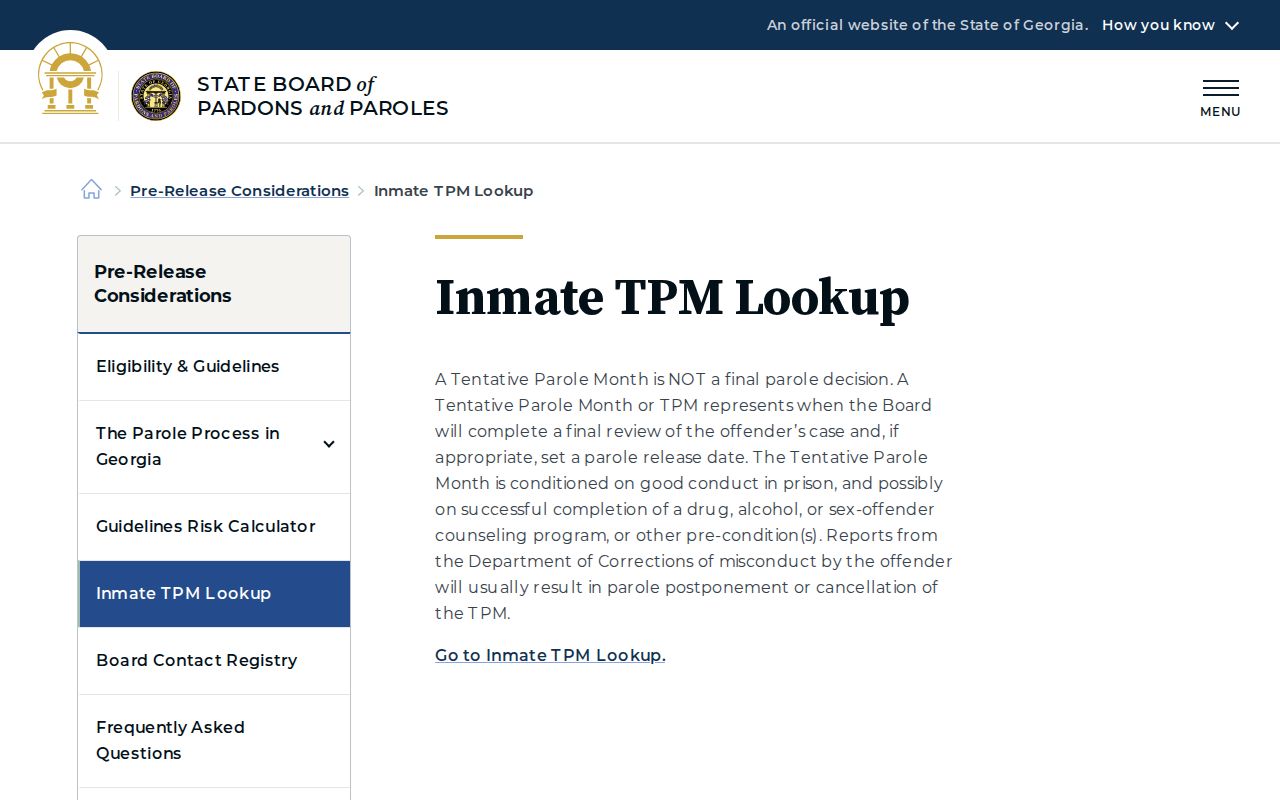
The screen reinforces that parole timing is a Board review process rather than a fixed county-jail release schedule.
Note: GDC asks users to verify online offender information through written correspondence with Inmate Records and Information before relying on it.
What Changes Columbia County Release Dates
A displayed date changes when the legal or administrative inputs change. Local and state systems use different inputs, so the effect is not always the same. A court order may shorten or end county custody. A separate warrant can prevent the person from leaving. In state prison, conduct and program completion affect parole review or incentive credit, while a mandatory sentence can block reductions.
| Factor | Possible effect | Confirm with |
|---|---|---|
| Bond accepted | Starts local release processing, but does not clear other holds | Detention Center and court |
| Court order or corrected credit | Changes the county sentence end or release authority | Court docket and jail records |
| Warrant or detainer | Delays release or sends the person to another agency | Jail and holding agency |
| Board parole decision | Sets, denies, or revises parole timing | State Board |
| Misconduct | May postpone or cancel a TPM | GDC and State Board |
| Program completion | May satisfy a parole condition or earn eligible PIC | GDC and State Board |
Columbia County PIC Date Credits
GDC's Performance Incentive Credit program, called PIC, may reduce an eligible offender's TPM or MRD by one to twelve months. Points come from case-plan completion, education or vocational improvement, work assignments, and good conduct. PIC is not open to every state prisoner. The research identifies exclusions that include death sentences, sentences of two years or less, life sentences, non-parole-eligible offenses, and mandatory-minimum categories such as covered serious violent felonies.
The GDC PIC program page should be read with the offender's sentence and eligibility rules. A possible credit is not an award. It also does not apply to an ordinary Columbia County bond release or compute a pretrial detainee's exit date.
A case plan links the possible credit to concrete work. Education, vocational progress, assigned details, and approved programs can earn points for an eligible offender. Good conduct remains vital. If the offender falls in an excluded sentence class, the same progress does not make PIC available. A public MRD or TPM should therefore be read with eligibility, not adjusted by a reader's own estimate.
The GDC program page shows how credits tie to the state release framework. Review the official Performance Incentive Credit description for the eligibility context.
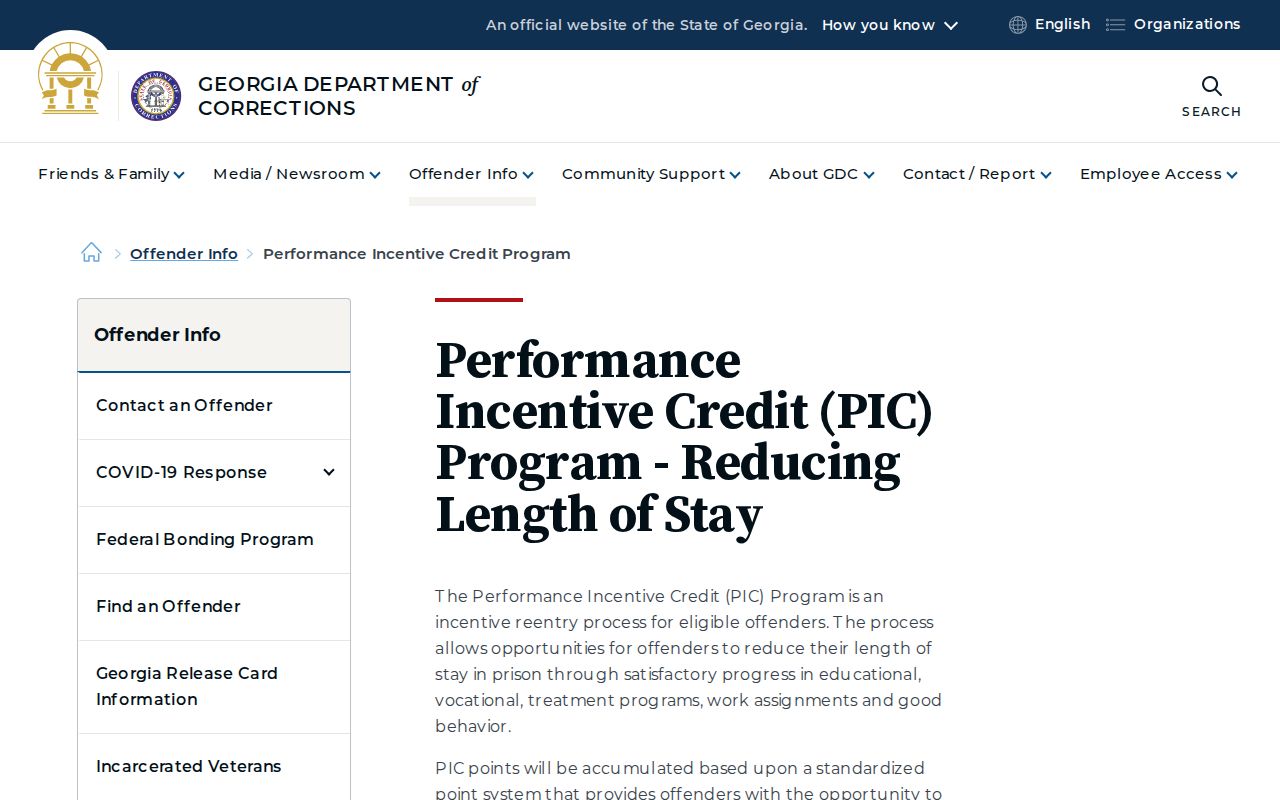
This state program can adjust an eligible TPM or MRD, but it does not replace the final release record.
Columbia County Parole Timing Law
Georgia law cannot be reduced to a broad claim that every person serves eighty-five percent. O.C.G.A. § 42-9-45 sets general parole eligibility rules. It provides different timing for misdemeanor, felony, and long aggregate sentences, while cross-referencing other limits. Board discretion still applies after eligibility. Eligibility means a case can be considered, not that the person will be released.
O.C.G.A. § 17-10-6.1 defines serious violent felonies and imposes mandatory-minimum and no-reduction rules for covered sentences. Some sentences must be served as imposed and are not cut by parole, earned time, early release, work release, or leave, apart from the statute's limited final-year transitional consideration. Life-sentence timing also depends on the offense date under State Board guidance.
The State Board describes different parole eligibility points for life sentences involving the covered serious violent felonies. Its guidance distinguishes offenses before the 1995 change, offenses after that change, and offenses on or after July 1, 2006. The research identifies review points of seven, fourteen, and thirty years for those date groups. These are eligibility rules, not automatic Columbia County release dates. A Board denial, later reconsideration, or statutory bar can still control.
Columbia County Jail Date Quirks
A local jail date can depend on sentence length, jail credit, commitment date, and a later court order. Bond cases follow another path. Columbia County accepts cash, property, and bondsman options, each with its own proof and processing requirements. Property documentation or another county's sealed bond can delay completion. Staff may process several releases at once.
Even after the legal basis is ready, the Sheriff's release workflow includes charge matching, identity verification, the wants-and-warrants check, movement to Booking, return of facility property, and reissue of personal items. That is why a court event or posted bond is not the actual release timestamp. Call 706-541-0754 for the live local custody question, then request the record if the date and reason must be documented.
A transfer also changes what “release” means. The county can end its own custody while sending the person to GDC, another jail, federal authorities, or ICE. In that event, the county release date is real, but it is not a community release. Ask for the transfer destination and date, then continue with the agency that took custody. The next system may calculate an entirely different projected date.
Property-bond processing has its own local variables. Columbia County requires local tax-assessment proof and valid identification for a property bond. Property from another Georgia county must move through that county's sheriff in a sealed bond. Larger property bonds need proof of equity, and a local bond carries the stated cash processing fee. These steps do not change the court's bond amount, but they can change when release processing is ready to begin.
Confirm Columbia County Actual Release
Use Georgia VINE or VINELink for a covered custody-status alert, then confirm through the agency record. VINE is useful when a release is pending, but it is not a certified court or corrections document. The Columbia County VINELink check explains the local county-jail notification route and the separate state V.I.P. channel.
For county custody, use the Detention Center and Sheriff's records office. For state prison, compare GDC, TPM, parolee status, and the sentencing docket. For federal custody, use BOP, whose release dates may change with federal credit recalculation. If an ICE detainer appears, county release may be a transfer to immigration custody rather than release to the community.
A formal county request can seek the release date and time, reason, bond status, charges, and transfer or hold information. A GDC request should include the full name, GDC identifier, facility, and approximate date. Court records can supply the judgment, jail credit, later orders, and probation terms. Reconcile those sources when one public screen is stale or incomplete.
Keep a record of the agency name and the label shown beside each date. A maximum date, tentative month, and actual release date should never be copied into one unlabeled timeline. When the sources conflict, ask the agency whether the public record is pending an update and request the underlying document.