
Columbia County Parole vs Probation
Parole and probation both place a person under rules in the community, but they start in different ways. Parole is conditional release from a Georgia prison sentence. The Georgia State Board of Pardons and Paroles makes that decision, and the Georgia Department of Community Supervision, or DCS, handles field supervision. Probation is imposed by a court. It can follow jail time, begin after a court-ordered release, or serve as an alternative to incarceration. DCS supervises felony probation in the local circuit. Neither status means the person remains in the Columbia County Detention Center.
The source that confirms the status depends on the stage. The Board's Inmate TPM Lookup is for a person still in prison or under parole review. Its tentative parole month is only a review point. The Georgia Parolee Search is the better public tool for a person already released to parole. A probation term is best checked against the sentencing docket and the supervising DCS office.
| Point | Parole | Probation |
|---|---|---|
| Who orders it | State Board after a prison sentence | Sentencing court |
| When it starts | On conditional prison release | As set in the court sentence |
| Public check | TPM lookup before release; parolee search after release | Court docket and DCS confirmation |
| Local contact | DCS Evans Field Office | DCS Evans for covered felony supervision |
| How it ends | Expiration or formal discharge | Completion or court action |
- Parole
- Conditional community release before the full prison term ends.
- Probation
- A court-ordered term of community supervision.
- TPM
- Tentative Parole Month, a review month rather than a promised release date.
- Discharge
- The formal end of custody or supervision.
- Absconder
- A supervised person alleged to have stopped reporting or left supervision without approval.
Verify Columbia County Post-Release Supervision
Start with the custody source, not a broad name search. Someone released from Augusta State Medical Prison may move to parole, a transitional center, or another DCS status. Someone released from the county jail may begin probation under a local court order. A person with a TPM may still be incarcerated. These paths look alike from a distance, but each has a different confirming record.
- Identify the last custody system. Use the county detention channel for a jail release and GDC records for a state-prison case.
- Check parole timing. Search the TPM tool if the person may still be in prison. Do not treat a displayed month as a final decision.
- Check released parole status. Search the Board's parolee database by name and review the parole begin and end dates.
- Read the court docket. The Columbia County Clerk case search can show sentence and proceeding history that explains probation.
- Confirm locally. Contact the Evans DCS office for the appropriate Columbia Circuit supervision route.
- Request the record when needed. Use the responsible Board, DCS, court, or corrections records channel for official proof.
The Columbia County released-inmate search and custody-system distinctions are covered on the Columbia County released inmates home page. A jail record proves that local custody ended. It does not, by itself, prove that parole or probation ended.
Note: A parolee-search match is evidence of parole status, while a TPM result can describe a person who remains in prison.
Columbia County Supervision Office
The DCS Evans Field Office is the local contact listed for Columbia County and the Columbia Circuit. It serves people under parole, felony probation, and other covered state supervision. The office is not the county jail and does not replace the State Board's parole decision record. It is the practical local route when a released person must report, when the correct field office is unclear, or when a court sentence points to community supervision.
7045 Evans Town Center Blvd
Evans, GA 30809
Phone: 706-447-6740
Hours: Monday-Friday, 8:00 a.m.-4:30 p.m.
Have the person's full name and, if known, a GDC identifier or court case number ready. Staff access and disclosure limits still apply. The office can route a supervision question, while a certified sentence or disposition remains a court-record request.
Columbia County Supervision Violations
Conditions are the rules attached to release or sentence. They may include reporting, approved residence, program participation, payment terms, or limits set by the Board or court. A claimed violation does not automatically tell a reader whether the person is back in custody. DCS may investigate, a court or Board may act, and a warrant may issue. An absconder is a person alleged to have stopped reporting or left supervision without permission. That label is different from a new conviction.
No official Columbia County public absconder list was found in the research. The Sheriff's Most Wanted and sex-offender pages should not be used as substitutes. Verify an alleged warrant with the Sheriff's Office, the appropriate court record, DCS, or the State Board's status channel. Georgia VINE can notify registered users about covered custody changes, but it is not a certified supervision record.
Columbia County Supervision Discharge
Supervision ends through the legal authority that created or administers it. A parole term may expire or end with a discharge order. Probation may end when the court-ordered term and conditions are complete, or through later court action. A parole begin date or end date in a public database is useful, but it should be reconciled with the Board, DCS, and court record when the status matters to a legal process or personal release plan.
Georgia Archives identifies Board clemency actions, parole certificates, discharge orders, and revocation orders as permanently retained state records. That retention rule applies to the State Board's records, not to a Columbia County jail roster. For an older state case, the Board record may outlast a public lookup result. For probation, the Columbia County sentencing docket and DCS records are the stronger paths.
Columbia County Parole File Review
Georgia's ordinary parole process is not a public courtroom hearing. The Board reviews a file that can include the legal investigation, personal history, GDC conduct and program information, and input from registered victims, prosecutors, judges, and members of the public. Board members vote. For many eligible non-life cases, the result may be a TPM or a denial. In eligible life cases, the Board grants or denies parole without using a TPM in the same way.
The Board's public operational meetings are also not calendars of individual inmate hearings. Its home and news pages publish monthly meeting notices and cancellations, but offender cases are not discussed at those meetings. Use the Georgia parole process, TPM lookup, and parolee search for person-specific timing and status. A prior decision may be reconsidered before release.
The decision framework also differs by sentence type. For many non-life cases, the Board may set a tentative month or deny parole. For a parole-eligible life sentence, the Board grants or denies parole and does not use the TPM in the same way. Georgia law and Board guidance set offense-specific eligibility rules, including special treatment for serious violent felonies and life sentences based on the offense date. Those rules establish when review may occur, but the Board still weighs the individual file.
The State Board publishes decision guidance that helps explain those votes. Review the official parole decision guidelines alongside the person's TPM or parole status.
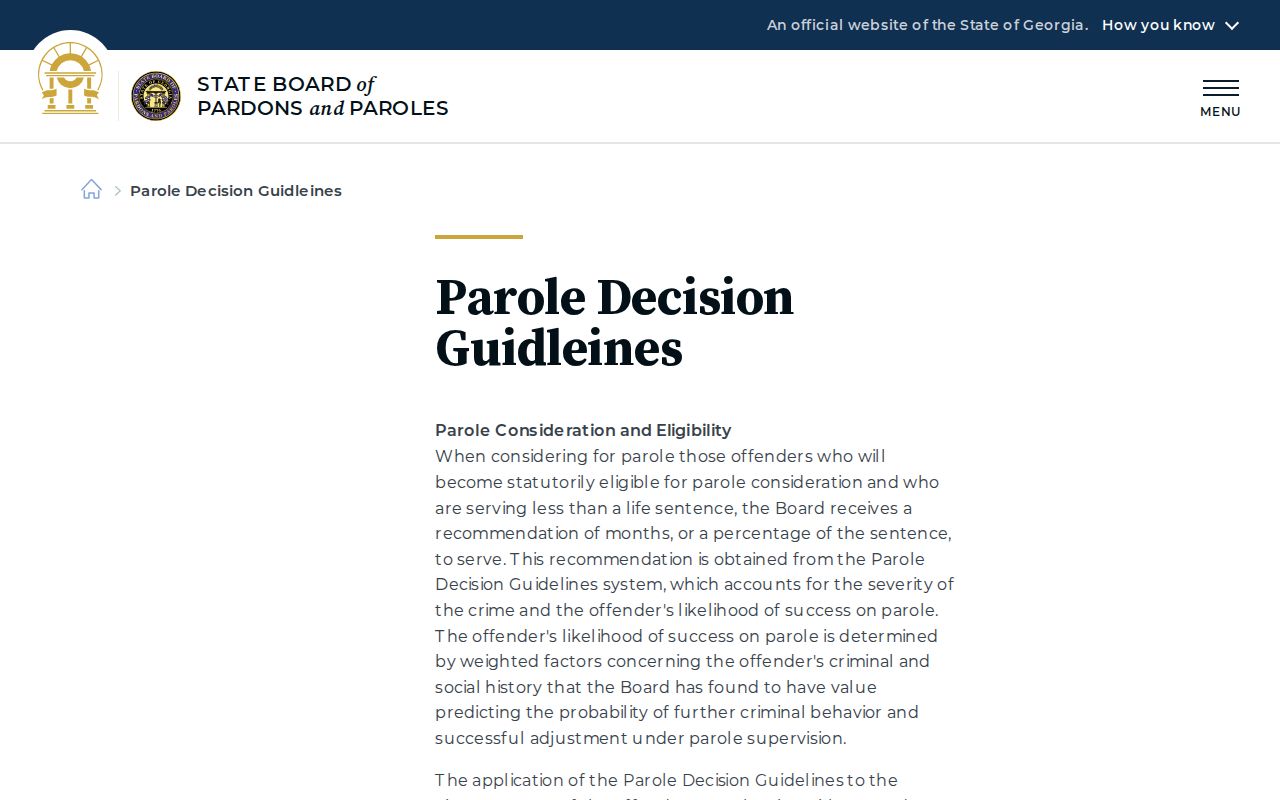
The state guidance provides context for a decision, while the person-specific lookup remains the source for that individual's public status.
Note: Eligibility means the Board must consider a case under its rules; it does not create a right to parole release.
Columbia County Reentry Supervision
DCS describes Day Reporting Centers as structured, non-residential programs for people under supervision. Their phases can include stabilization, sobriety, and aftercare. A Day Reporting Center is not a jail and is not proof that a person remains incarcerated. It is one possible state supervision and reentry setting after release.
This distinction matters in Columbia County because the Evans office is a local bridge between prison release, parole, felony probation, and community reporting. A person can live in the community while still following a dense set of terms. The DCS Day Reporting Center overview explains the program model, while the Evans office handles the local route.
Release notifications operate on another track. Columbia County says its Detention Center uses Georgia VINE for covered jail custody changes. The State Board's V.I.P. program addresses state-prison and parole-related notifications, including release after the court-ordered term, release to begin probation, and parole release. These tools can alert a registered person, but DCS and Board records remain the better sources for the terms and end of supervision.
Property After Columbia County Release
Supervision status and release-day property are separate records. Columbia County says an inmate may authorize money release through a form. Funds are then available by check during the listed weekday pickup hours, excluding holidays, and valid photo identification is required. The jail also allows property release to another person through a property-release form, with valid photo identification required for pickup.
Those steps can help a family resolve property or funds after the person enters parole or probation. They do not confirm the supervision term. Use the Detention Center's General Information page for property and money procedures, and use DCS or the State Board for the actual supervision status.