
Transitional Center Release Paths
Augusta Transitional Center is a late-stage state-custody setting. GDC says residents are assigned to work release and permanent details. Work release lets an eligible resident work in the community under program rules, but it is not proof that GDC custody ended. A person may return to the center after work and remain listed in the state system.
The next step can be parole, a court-ordered probation term, sentence completion, another GDC placement, or a return to more secure custody. Confirm both the movement and the legal status. A parole record shows conditional community release. A GDC discharge record shows the state-custody event. DCS can confirm local supervision after the person returns to Columbia County.
| Stage | Custody meaning | Record source |
|---|---|---|
| Work release | Resident may work outside but remains in the program | GDC facility status |
| Parole | Prison custody ends under conditions | State Board and DCS |
| Probation | Court supervision may start or continue | Court and DCS |
| Discharge | Relevant state custody term ends | GDC written record |
Confirm Augusta Transitional Release
Use GDC Find an Offender for the statewide custody record. Search with the full name and add a GDC ID, case number, age, or other facts when known. The correct result may show a current institution, sentence information, and release-related fields. A photograph can appear automatically. Check the identity carefully before drawing any conclusion.
A short confirmation sequence keeps each source in its proper role:
- Search the GDC record and confirm Augusta Transitional Center or its host relationship.
- Check a displayed maximum date or custody status, but treat it as an online lead.
- Use the State Board TPM lookup if parole timing is still tentative.
- Use the parolee search if the person may already be on parole.
- Contact DCS Evans for supervision in Columbia County or request written GDC verification for discharge.
The Columbia County released-inmate record route is appropriate only if a separate Columbia County jail booking also exists. County detention staff do not certify release from this state program.
Transitional Center Records Contact
GDC lists Augusta Transitional Center at 601 Taylor Street in Augusta. The facility telephone number is 706-721-1650, and the fax is 706-721-1798. Facility staff can address current institutional contact and program questions. For a historical discharge record, GDC central records is the more suitable source.
601 Taylor Street
Augusta, GA 30901
706-721-1650
Fax: 706-721-1798
GDC Inmate Records and Information
PO Box 1529
Forsyth, GA 31029
404-656-4661
A focused request should give the person’s full name, GDC ID, date of birth, sentencing case if known, facility, and approximate movement or release date. Ask whether the record shows transfer, parole release, sentence completion, or another disposition. GDC cautions that online offender data should be verified by personal written correspondence before it is treated as complete.
Augusta Transitional Center Profile
The official GDC location page describes a minimum-security center for adult male felons. It opened in 2002 and has a stated capacity of 230. Augusta State Medical Prison serves as host facility. That host link places the center within the Columbia County release geography even though the Taylor Street address is in Augusta.
The official facility source appears in the image below.
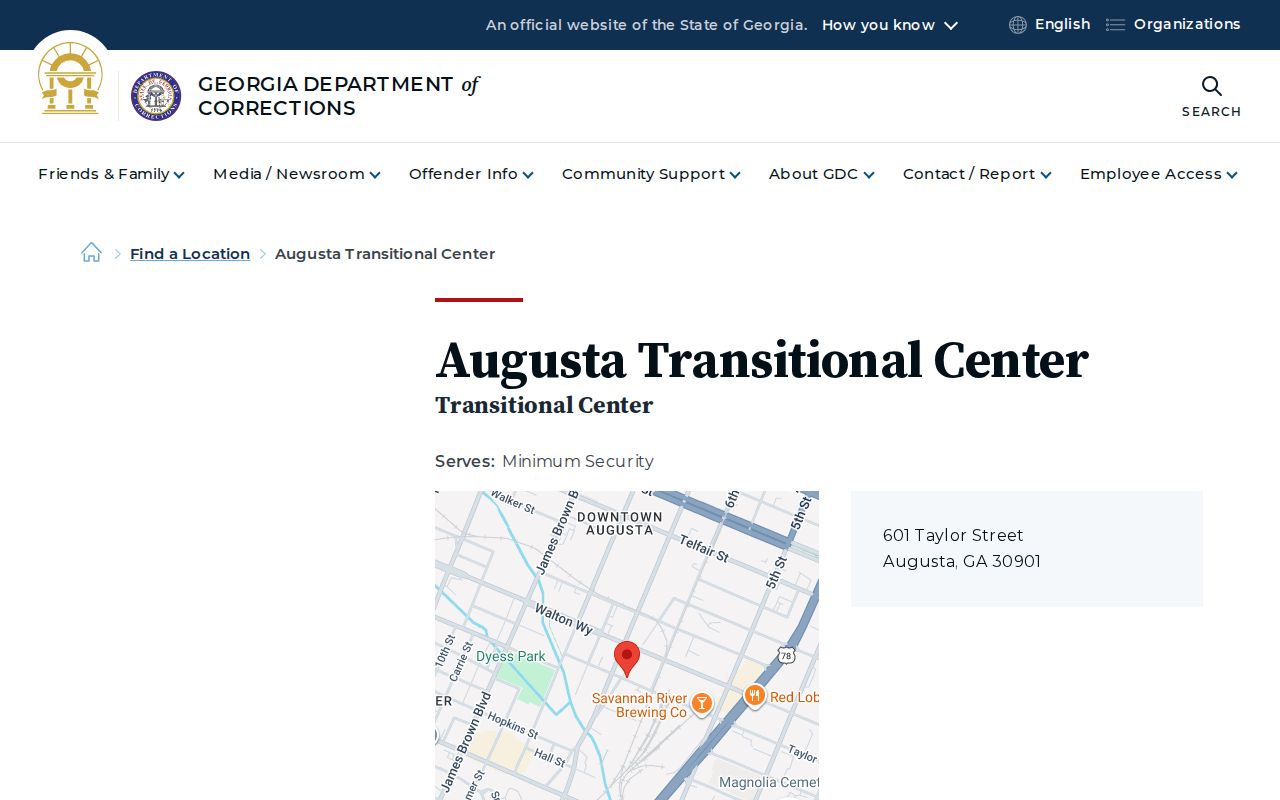
The image confirms the state-operated center and its role. It does not show a particular resident’s current custody or release status.
Host Prison Shapes Release Records
GDC names Augusta State Medical Prison as the host for Augusta Transitional Center. The host prison is a close-security medical institution in Grovetown, while the transitional center is a minimum-security community-return setting. A movement between them is a GDC custody event, not necessarily release.
This local structure is distinctive. Columbia County’s release landscape includes a state medical prison and the transitional program it hosts. When a search result lists one facility and a later record lists the other, ask GDC for the movement history and present status. A transfer date should not be relabeled as a release date.
Residents connected to Columbia County may enter the center through state sentencing and placement decisions, not through a direct county-jail release list. Their court file can explain the sentence. GDC explains custody. The State Board explains parole. DCS explains supervision after return.
Transitional Release Date Meaning
Georgia records use several date terms. A Maximum Release Date is tied to the sentence. A Tentative Parole Month is when the Board expects final review and might set a parole date. Neither should be described as the actual day a resident leaves. A final date can change with conduct, program requirements, detainers, court orders, and Board action.
GDC’s Performance Incentive Credit program may reduce a TPM or maximum release date for eligible people by one to twelve months. Credits depend on case-plan work, education or vocational improvement, assignments, and good conduct. Many categories are excluded. The record must be read under the person’s actual offense and sentence.
- Work release
- Structured outside work while the resident remains in the program.
- TPM
- A conditional parole-review month, not a guaranteed departure.
- Parole
- Release from prison custody into supervised community status.
- Discharge
- Formal completion of the relevant custody or supervision term.
Columbia County Supervision Return
The Evans DCS Field Office serves Columbia County and the Columbia Circuit. A former Augusta Transitional Center resident who returns to the county on parole or felony probation may report through that office. It is located at 7045 Evans Town Center Boulevard, Evans, Georgia 30809. Hours are Monday through Friday from 8 a.m. to 4:30 p.m., and the phone is 706-447-6740.
DCS also describes Day Reporting Centers as non-residential, structured programs with phases of close supervision. A day reporting assignment is not incarceration at Augusta Transitional Center. It is a supervision setting after or instead of confinement. Verify the exact program and reporting office before assuming where the person must appear.
Still Held or Released
Current GDC placement and community release can look similar when a resident is working outside. The key question is legal custody. If the person remains assigned to Augusta Transitional Center, GDC still controls the custody record. If parole has begun, the State Board and DCS become central. If the sentence is complete without supervision, GDC’s discharge record is the clearest state source.
V.I.P. may provide incarceration location, parole eligibility, maximum or scheduled release date, and an indication that the person is not in custody for covered users. It is a notification and status channel, not a certified discharge. Written records remain the fallback when online fields conflict.
Note: A community work assignment can precede release by weeks or months, so confirm legal status instead of relying on where the person was seen.
Augusta Transitional Status Sources
The State Board’s parolee search serves a later stage than the TPM tool. A parolee entry can include parole begin and end dates, showing that the person moved from prison custody into supervised release. The TPM tool belongs to the review stage and cannot confirm that the resident actually departed Augusta Transitional Center. If neither search resolves the status, the GDC custody record and direct written verification take priority.
A court disposition adds the sentence behind the placement. It can show a prison term, probation to follow confinement, jail credit, or a later order. DCS then supplies the local supervision path for someone returning to Columbia County. Reconciling the court, GDC, State Board, and DCS records prevents a work-release assignment from being mislabeled as parole or final discharge.
V.I.P. notifications may continue until the assigned PIN is entered. That repeated notice process is designed for status communication. It still does not state every detail of the center’s movement record. Ask GDC for the public record when the exact departure date, destination, or formal discharge type is needed.
The center's own profile adds useful identity checks. GDC lists Augusta Transitional Center as a minimum-security placement with capacity for 230 residents, opened in 2002, at 601 Taylor Street in Augusta. Augusta State Medical Prison is the named host facility. Those facts help distinguish a transitional placement from release to a nonresidential DCS Day Reporting Center. A person at the transitional center remains in a GDC release pathway, while a person reporting to DCS is in community supervision. If two records use different locations, compare the effective dates before deciding that one is wrong. One may show the last GDC placement and the other the later supervision office.
Public Record Search
Sponsored Results